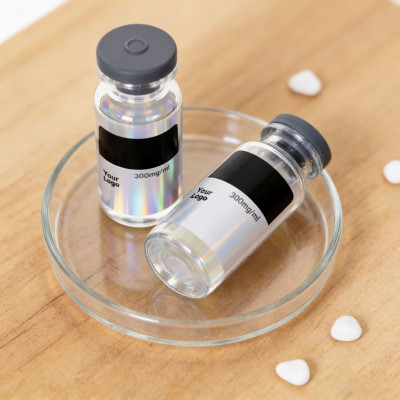
Tamper-Evident Packaging for Pharma & Cosmetics: 2026 Guide
If your search history looks like tamper evident packaging pharma cosmetics, you are really juggling three different rulebooks at once: a U.S. over-the-counter drug rule that has been on the books since 1982, an EU medicines directive whose anti-tampering device requirement turned five years old in 2024, and a cosmetics category where almost everything is voluntary — until a resold or refilled jar ends up in a customer's bathroom. This guide maps all three, then gets concrete about the label-level design choices that make a package both compliant and hard to fake.
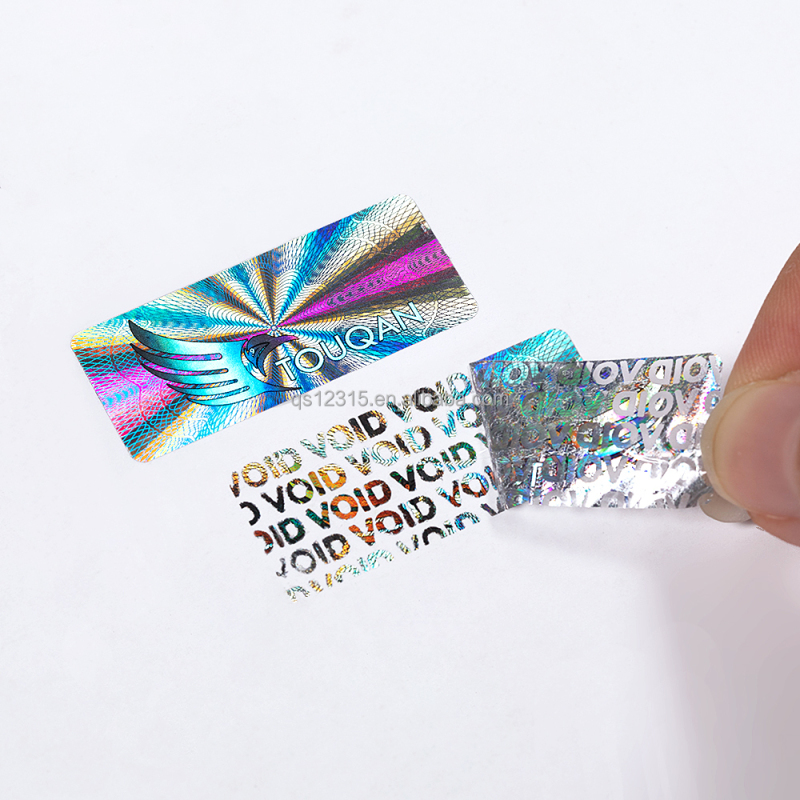
A tamper-evident label does its job in two states: intact on the shelf, and obviously broken afterwards.
Three Rulebooks, One Package
Tamper evidence is not one regulation. Which rules apply to tamper evident packaging in pharma, cosmetics, and adjacent categories depends on what is in the box and where it is sold:
| Product & market | Rule | What it requires | Since |
|---|---|---|---|
| OTC drugs, U.S. retail | 21 CFR 211.132 | At least one indicator or barrier to entry that shows visible evidence of tampering; distinctive by design or carrying an identifying characteristic; labeling statement naming the feature(s) | 1982 (Tylenol), amended 1989/1998 |
| OTC drugs in two-piece hard gelatin capsules, U.S. | 21 CFR 211.132(b) | Capsule sealing technology required in addition to package features | 1989; sealing tightened 1998 |
| Most prescription (and some OTC) medicines, EU/EEA | Directive 2011/62/EU + Delegated Regulation (EU) 2016/161 | Unique identifier (2D DataMatrix) plus an anti-tampering device on the outer packaging | 9 Feb 2019 |
| Cosmetic liquid oral hygiene & vaginal products, U.S. | 21 CFR 700.25 | Tamper-resistant packaging (contact lens solutions: 21 CFR 800.12) | 1980s |
| All other cosmetics, U.S. | No general federal mandate | Voluntary — market practice and brand risk drive the decision | — |
One boundary worth stating early: the U.S. Drug Supply Chain Security Act (DSCSA), which since 27 November 2023 requires electronic, interoperable, package-level tracing for prescription drugs, is a digital serialization layer. It does not replace a physical anti-tampering device — and it does not cover OTC drugs at all. Compliance in pharma means both layers: a scannable identity and a physical seal.
What 21 CFR 211.132 Actually Asks For
The U.S. rule was written in response to the 1982 Chicago Tylenol poisonings, in which seven people died from cyanide-laced capsules. FDA's answer, first codified in November 1982, is deliberately technology-neutral. A compliant package must give "visible evidence to consumers that tampering has occurred," and the feature must be distinctive by design — or carry an identifying characteristic such as a pattern, logo, or registered trademark that a counterfeiter cannot duplicate with household materials. The labeling statement must name the specific feature(s), and it must be placed where it stays readable even if the feature is breached or missing.
Two details trip up newcomers. First, the exemptions are specific — dermatological products, dentifrices, insulin, and lozenges are carved out; everything else at retail is in scope. Second, FDA's compliance policy (CPG Sec. 450.500) is blunt about technologies that no longer qualify: cellophane wrappers with overlapping end flaps can be opened and resealed invisibly, tinted wrappers are no longer acceptable as an identifying characteristic, and cellulose wet shrink seals are out. Heat shrink bands, blister and strip packs, bubble packs, and properly designed film wrappers remain the reference designs.
The EU's Anti-Tampering Device: FMD in Practice
In the EU, Directive 2011/62/EU and Delegated Regulation (EU) 2016/161 require two safety features on the outer packaging of most prescription medicines (and some OTC medicines) since 9 February 2019: a unique identifier printed as a 2D DataMatrix — product code, serial number of up to 20 characters, batch and expiry — and an anti-tampering device. The manufacturer uploads the identifier to the EU medicines verification system before release; pharmacies and hospitals scan and "decommission" each pack at the point of supply, which is exactly what makes a cloned identifier dangerous to reuse.
The regulation does not prescribe the device. Guidance on suitable tamper verification features is collected in the European standard EN 16679:2014, and the choice belongs to the marketing authorisation holder. Two footnotes matter for 2026 planning: Greece and Italy operated legacy national tracking systems under a deferral that ran to 2025, and after Brexit the FMD safety-features regime no longer applies in Great Britain — though Northern Ireland retains it under the Windsor Framework. If you ship both GB and NI, the same pack may need different features per lane.
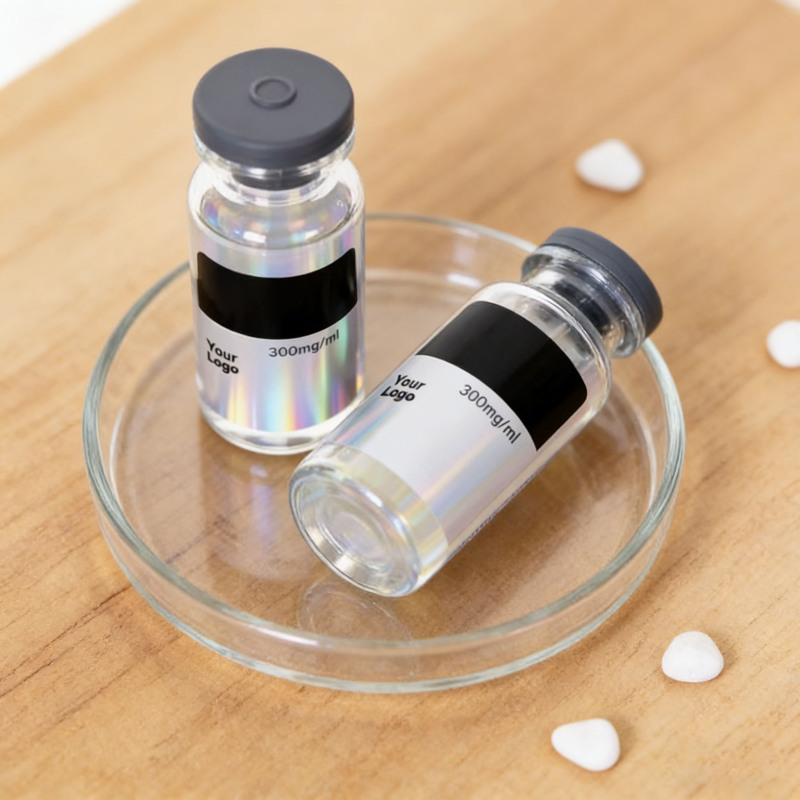
Primary packaging counts too: vial seals and carton closure labels are both candidate anti-tampering devices under EN 16679:2014.
Design Principles That Survive Contact With Reality
Whether the trigger is 211.132 or EN 16679:2014, the design criteria converge. A tamper-evident feature must be:
- Visible, not inferable. The breach evidence has to be obvious to an ordinary consumer, not to a trained inspector with a loupe.
- One-way. Opening must destroy or permanently mark the feature. If it can be worked off and reapplied without visible damage, it fails — that is the explicit test FDA applies to shrink bands.
- Durable through the chain. The feature must survive filling, casing, palletizing, transport, and shelf stocking without false alarms. A seal that fails in transit trains everyone to ignore it.
- Distinctive or marked. Generic, freely available materials cannot be the feature; add a proprietary pattern, logo, or per-SKU identifying characteristic.
- Labeled. Tell the consumer what to look for, and where. An unlabeled seal protects less, and in the U.S. the labeling statement is itself required.
Notice what is not on this list: "tamper-proof." No package is tamper-proof, and FDA itself retired the term in favor of tamper-evident in 1998. Marketing copy that overclaims invites regulatory attention; the honest framing is that the package makes interference visible.
VOID Labels: The Flexible Middle Ground
Between a shrink band and a full blister redesign sits the most adaptable option: the reveal-on-lift VOID label. Applied across a carton closure, a cap, or a jar lid, it behaves like a one-way feature — lifting it leaves a VOID pattern on the substrate and destroys the label, so the pack cannot be opened and resealed cleanly. Unlike a shrink band, it can carry the same overt and covert layers as any other security label: holographic imagery, micro-text, UV inks, even a serialized QR or NFC tie-in, which converts "was this opened?" into "was this opened, and is this unit genuine?"
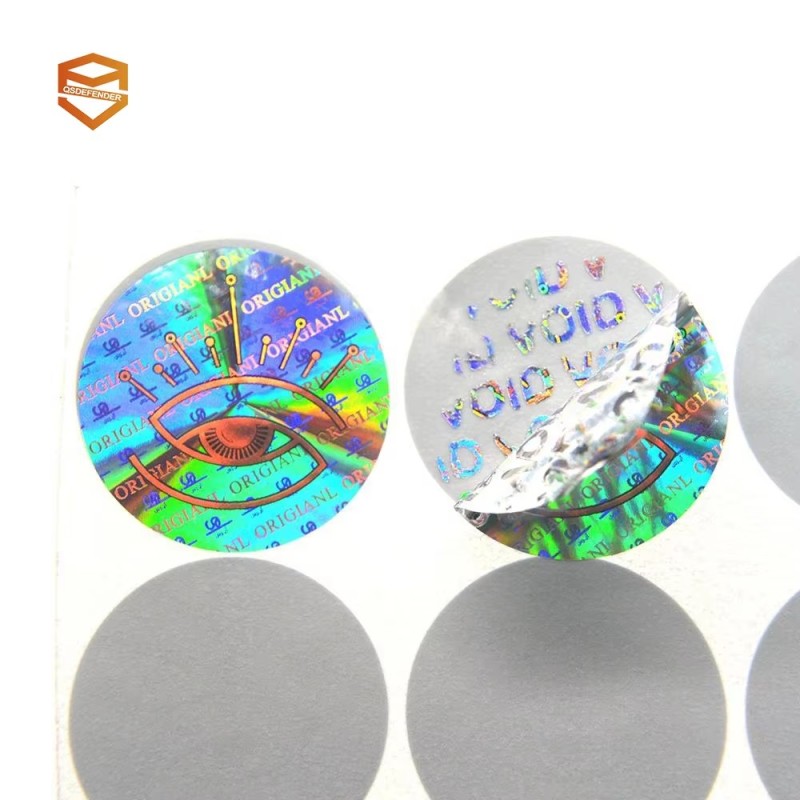
Reveal-on-lift VOID labels: the breakdown is visible on both the label and the surface it protected.
We cover the mechanism in depth in VOID Stickers: How the Reveal-on-Lift Effect Deters Tampering, and the visible-defense layer more broadly in Holographic & VOID Tamper-Evident Labels: Visible Defense. For how tamper evidence fits into a multi-layer program, Layered Authentication: Why One Feature Is Never Enough is the companion read.
Pharma: Pair the Seal With the Serial
For EU-bound prescription products, the anti-tampering device and the DataMatrix arrive together, and they are checked together — wholesale recipients verify the identifier and inspect the device. Design them as one artifact where possible: a closure label that carries the DataMatrix inside a VOID boundary means a tampered pack also breaks the scan story, and vice versa. For U.S. prescription drug supply chains, DSCSA's electronic, package-level tracing (exchanged in practice via GS1 EPCIS since the 27 November 2023 deadline) handles "is this unit legitimate?", while 211.132-grade physical evidence still handles "has this pack been opened?" Teams preparing for the serialization compliance conversation will find the supplier-side checklist in our packaging technology guide.
Cosmetics: Voluntary, Until It Isn't
Outside the narrow U.S. exceptions (liquid oral hygiene and vaginal products), cosmetics carry no general tamper-evident mandate. But the threat model is real: refilled premium jars, counterfeit re-seals, and returns fraud all exploit packaging that opens and closes invisibly. The practical playbook we see work:
- Shrink bands or induction seals on anything with a screw cap — cheap, familiar, one-way.
- VOID closure labels on jars and compacts, where a band would ruin the unboxing aesthetic; matte or lightly branded VOID films keep the shelf look intact.
- Serialized verification for the units that matter most: a QR or NFC code inside the closure area means the reseller's "factory-sealed" claim is testable by the end customer. The implementation playbook for that layer is in our QR implementation guide.
The design trade-off is honest: every one-way feature taxes the second use of the pack and the returns process. Decide per SKU which risk is larger — a tampered unit reaching a customer, or a legitimate return that now needs manual inspection.
Five Mistakes That Show Up in Real Audits
- Resealable-by-design "seals." A sticker that peels off intact is decoration. Test your own feature by trying to reapply it.
- Generic materials as the feature. An off-the-shelf shrink band with no identifying characteristic is exactly what "distinctive by design" exists to prevent — counterfeiters buy the same band.
- Labeling statement afterthoughts. In the U.S., the statement must name the feature(s) and survive a breach. Fine print on the cellophane you just tore off does not comply.
- Conflating tamper evidence with child resistance. They are separate regimes (child-resistant packaging under the Poison Prevention Packaging Act); a CR cap is not automatically tamper-evident.
- Ignoring the reseal threat in beauty. Counterfeiters rarely tamper at the factory — they tamper in distribution. If your pack opens cleanly, the outer box security does the real work.
Boundaries of This Guide
This is an engineering and packaging-design perspective, not legal advice; confirm scope and current dates with your regulatory affairs team or notified body, because exemptions, market lanes (GB vs. Northern Ireland being the live example), and national annexes change. Where figures above describe regulations, they quote the FDA, EMA, and gov.uk sources listed below; we have no visibility into your specific marketing authorisations. Production feasibility — substrate, line speed, label count — we quote per project.
Want a closure seal that passes audit and survives the line?
Our team designs tamper-evident label structures against EN 16679:2014 and 21 CFR 211.132 expectations — including VOID closure labels with serialized verification built in. Talk to us about compliance-ready label design.
Sources & further reading: EMA, Falsified medicines: overview (Directive 2011/62/EU, Delegated Regulation (EU) 2016/161); gov.uk, Application of the FMD Safety Features in Northern Ireland (EN 16679:2014, Windsor Framework); FDA, CPG Sec. 450.500 and the 1998 final rule Tamper-Evident Packaging Requirements for OTC Human Drug Products (63 FR 59463); DSCSA enhanced distribution security from 27 November 2023 per FD&C Act section 582(g)(1). Article prepared with AI assistance and reviewed by the QSDEFENDER engineering team.