Dietary Supplements & Nutraceuticals Anti-Counterfeiting: The 2026 Brand Playbook
Why Supplements Are the Highest-Stakes Category You Have Not Protected Yet
If you manufacture or brand dietary supplements, nutraceuticals or sports nutrition, you sit in a category where a counterfeit is not just a lost sale — it is something a consumer swallows. Counterfeit and adulterated supplements are routinely found to contain undeclared prescription drugs, unapproved synthetic opioids, heavy metals or none of the active ingredient on the label. The harm lands on the person who trusted your name on the bottle. Yet across the anti-counterfeiting playbook, ingestible products remain one of the least-covered categories: our own audit of 60 English posts found the pharmaceutical, cosmetics, wine & spirits, automotive and electronics verticals all covered — but zero dedicated supplement articles. This guide closes that gap. (For the wider picture, see our 2026 trends outlook.)
The Adulteration Economy, in Numbers
These are documented enforcement facts, not edge cases. They define the baseline for every brand selling ingestible products:
| Metric | Scale | Source |
|---|---|---|
| Undeclared drug ingredients found in products marketed as "natural" supplements (cumulative) | 1,000+ tainted products since 2007; sexual-enhancement ≈46%, weight-loss ≈35%, muscle-building ≈12% | FDA Tainted Supplements Database (as compiled 2025) |
| FDA 2025 health-fraud recalls for undeclared pharmaceuticals | Multiple recalls — e.g. sildenafil/tadalafil in "male enhancement" supplements (16 Dec 2025), propoxyphenylsildenafil (6 May 2025) | FDA "2025 Recalls — Health Fraud" |
| FDA / DOJ seizure of illegal 7-OH opioid products | ≈73,000 units, ≈US$1M value, three Missouri firms (Dec 2025) | FDA enforcement action (2025) |
| Independent quality failures in tested supplements | ≈21% of tested products failed quality review (2023) | ConsumerLab annual survey (2023) |
| Global dietary-supplement market size (2025) | Est. US$150–220B depending on source; online channels ≈40%+ | Multiple market reports (range reflects methodology) |
Sources accessed 28 Nov 2026: US FDA (Tainted Supplements Database; "2025 Recalls — Health Fraud"; 7-OH seizure); ConsumerLab 2023 survey; industry market reports. Market-size figures vary widely by methodology and are quoted only to show scale. Statistics are lagging measures, not a live real-time counterfeit rate.
Why Fake Supplements Are a Public-Health Emergency
The threat goes well beyond lost revenue. In 2025 alone, FDA recalled dietary supplements carrying undeclared sildenafil and tadalafil (prescription erectile-dysfunction drugs), dexamethasone and diclofenac (a steroid and an NSAID), and analogues such as propoxyphenylsildenafil — none of which may legally appear in a supplement. In December 2025, FDA and the US Department of Justice seized roughly 73,000 units of products containing concentrated 7-hydroxymitragynine (7-OH), an opioid that cannot legally be added to supplements or conventional foods. Separately, independent testing has repeatedly found products with less of the active ingredient than the label claims, contaminants above safe levels, or ingredients not present at all. None of this is visible on the shelf. A consumer cannot tell what is inside the capsule, how it was made, or whether the maker controlled the supply chain — which is exactly why brand-controlled verification matters.
A Five-Layer Defense, Not a Single Sticker
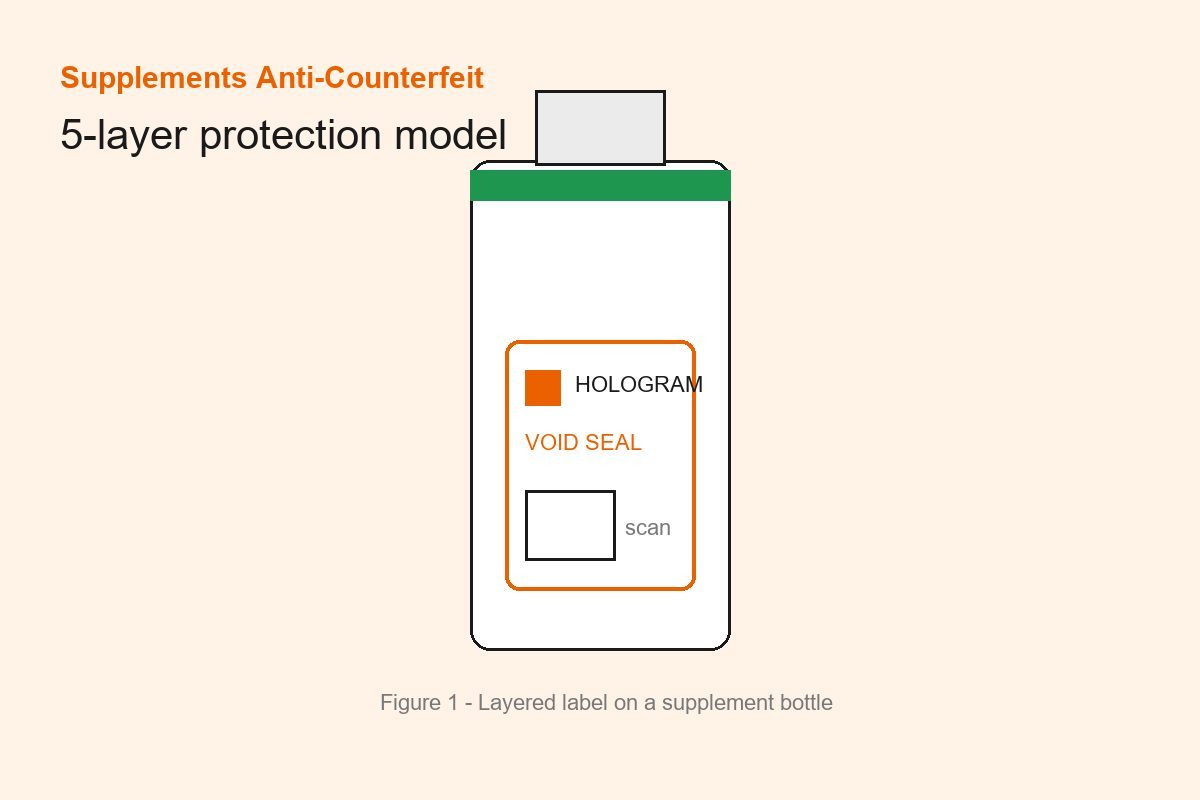
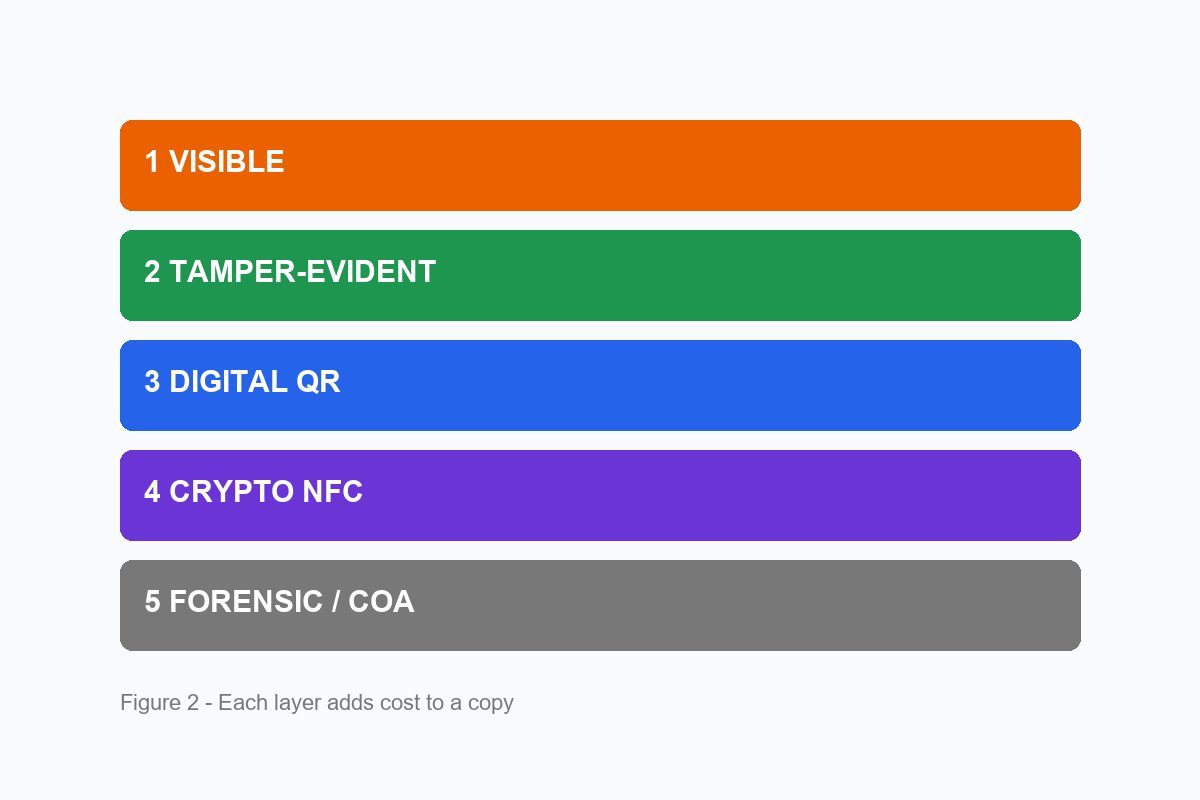
One feature is never enough. The same layered framework we apply across industries works especially well for supplements, where packs are small, high-value and easy to resell:
1 · Visible
A registered hologram or colour-shift seal gives a "look-and-feel" cue at the shelf. See Hologram 101 and the hologram + QR hybrid.
2 · Tamper-evident
A VOID seal, induction band or destructible label proves the bottle was never opened or refilled. Our tamper-evident packaging guide covers the mechanics.
3 · Digital (QR)
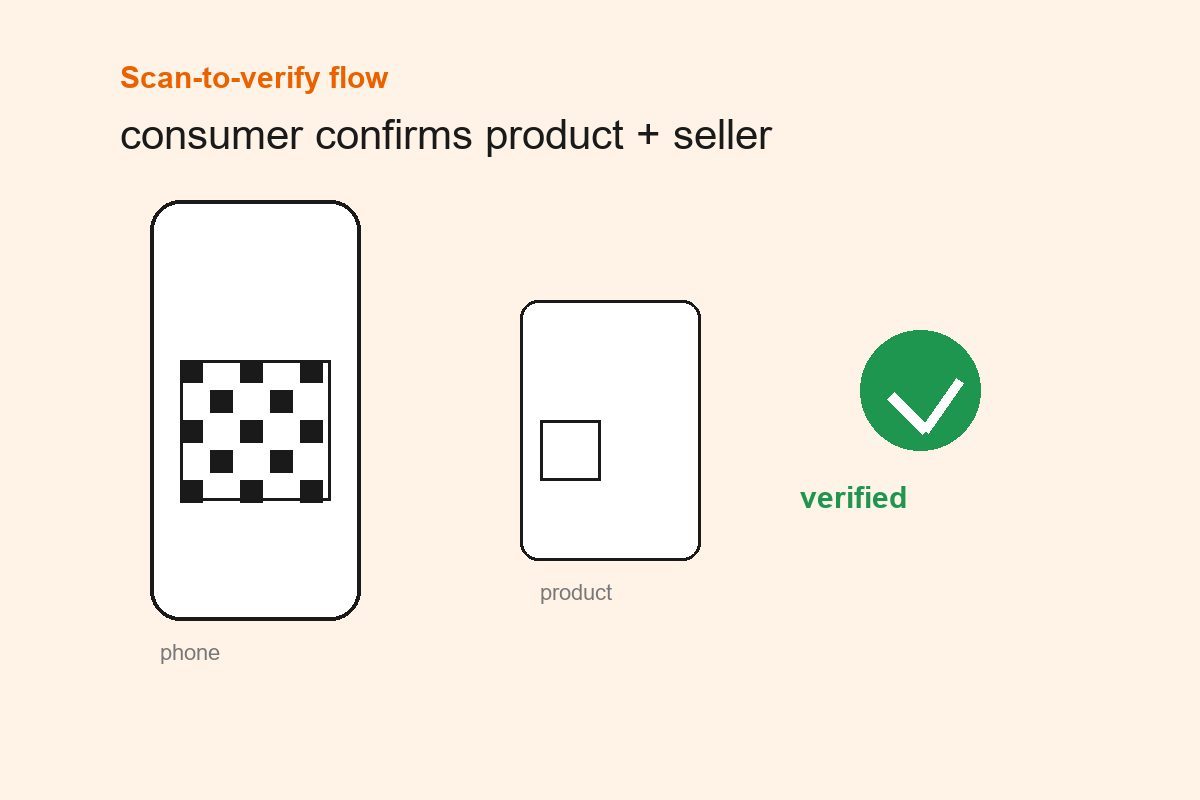
A serialized or dynamic QR ties each pack to a backend record consumers can scan. One code can also serve checkout, content and authentication. Avoid the five QR mistakes that let counterfeiters copy you.
4 · Cryptographic (NFC)
For premium lines, an NTAG 424 DNA tap proves authenticity cryptographically — no app, no cloned code. See the NTAG 424 DNA explainer and the RFID/NFC buyer's guide.
5 · Forensic / release testing
Covert markers and batch-level release data let a brand or lab confirm a suspect pack after sale. Layer them with the visible and digital features above — and pair them with the layered-authentication framework.
Match the Layers to the Brand Tier
Not every SKU needs all five layers. Spend where the risk and the margin are:
| Brand tier | Typical risk | Recommended minimum |
|---|---|---|
| Mass / D2C | Marketplace listing hijack, refill-and-resell | Serialized dynamic QR + tamper-evident seal; verify on the brand site. |
| Premium / clinical | High-resale fakes, gift-box diversion, ingredient substitution | QR + registered hologram + VOID; consider NFC on hero SKUs and publish batch COAs. |
| Sport / celebrity line | Clone quality high, banned-substance risk, serial replay | QR + hologram + covert forensic + NFC on the hero line; per-unit serialization and third-party sport certification. |
Regulation vs. Authentication: Know the Boundary
A frequent confusion: brands assume a "supplements anti-counterfeit law" exists and that a security label satisfies it. It usually does not. The major supplement regimes govern safety, registration and labelling — they do not mandate a brand's anti-counterfeit label:
| Regime | What it actually mandates | Where authentication helps |
|---|---|---|
| US · DSHEA + 21 CFR 111 Dietary Supplement Health and Education Act, 1994; cGMP effective 2007 | FDA does not pre-approve supplements. Firms must follow current good manufacturing practices, register manufacturing facilities, substantiate structure/function claims, carry a Supplement Facts panel and a domestic adverse-event contact, and notify FDA 75 days ahead for a new dietary ingredient. | A scannable code can surface the registered product, the authorised seller and the batch — evidence a buyer or regulator can check. |
| EU · Directive 2002/46/EC Food supplements; Novel Food Reg. (EU) 2015/2283 | National notification, permitted vitamin/mineral forms and labelled nutrient amounts; substances new to the EU food supply (reference date 15 May 1997) need Novel Food authorisation. | A QR can carry the notification reference and responsible-person contact so a buyer verifies legitimacy across member states. |
| China · Health Food registration & filing 注册与备案双轨制 (SAMR) | Dual-track registration/filing, ingredient-directory conformity, safety assessment and labelling for "health food" claims. | The traceability and anti-diversion duty is where a unit-level code earns its place. |
Authentication is the layer a brand adds to make its compliant pack verifiable per unit — it does not replace the legal duties above, and independent quality marks such as USP Verified, NSF Certified for Sport or Informed Choice are a separate, testing-based layer. Our DSCSA supplier guide shows the same pattern in pharma, the cosmetics pillar covers the parallel ingestible/applied category, and the India compliance guide shows how regional rules differ.
A Six-Step Path From Risk to Protection
- Risk-rank your SKUs. Flag hero, high-resale and sport/celebrity lines first; mass SKUs can start with QR + tamper seal.
- Lock the legal label first. Supplement Facts, ingredient list, responsible-person / registrant contact and the required disclaimer go on the pack under DSHEA / 2002/46/EC / Chinese rules before any security feature.
- Choose the code architecture. Serialized dynamic QR for most lines; add NFC and per-unit serialization only on premium or sport heroes. See the RFID ROI cost model to justify the spend.
- Add the physical layer. A registered hologram and a tamper-evident seal protect the statutory panel where no scanner is present.
- Close the loop. Make the code resolve to brand-controlled data, monitor scan anomalies (geography, repeat codes), and keep batch records ready for platforms and regulators — the same scan-to-alert logic used against diversion.
- Operationalise it. Turn this into a worksheet with our 2026 buyer's checklist and the 7-step brand-protection framework; if you sell on marketplaces, align with our Amazon Transparency guide and the EU DPP readiness guide.
Frequently Asked Questions
Is an anti-counterfeit label mandatory for supplements?
No general law makes a generic anti-counterfeit label mandatory. DSHEA/21 CFR 111, EU Directive 2002/46/EC and China's registration/filing rules govern safety, manufacturing, registration and labelling; a hologram or QR is a brand-protection measure you add on top. Third-party quality marks (USP, NSF, Informed Choice) are voluntary testing programmes, not a legal label requirement.
Does a QR code actually reduce counterfeits?
It reduces them when the code is serialized or dynamic and resolves to brand-controlled data, and when consumers are told to scan. A static, photocopiable code alone does little — see the QR mistakes guide.
Won't a QR just reveal my supplier or formula?
No — the public page is designed by you. It can confirm the product, batch and authorised seller while keeping supplier names and formulation data private. Keep the verification record separate from your manufacturing documents.
Which tier needs NFC?
Usually premium-to-luxury or sport hero SKUs where clone quality is high and banned-substance or serial-replay risk is real. Mass and D2C lines typically start with QR + tamper-evident seal.